Maximilianstrasse Innsbruck – A late homage to the Habsburgs
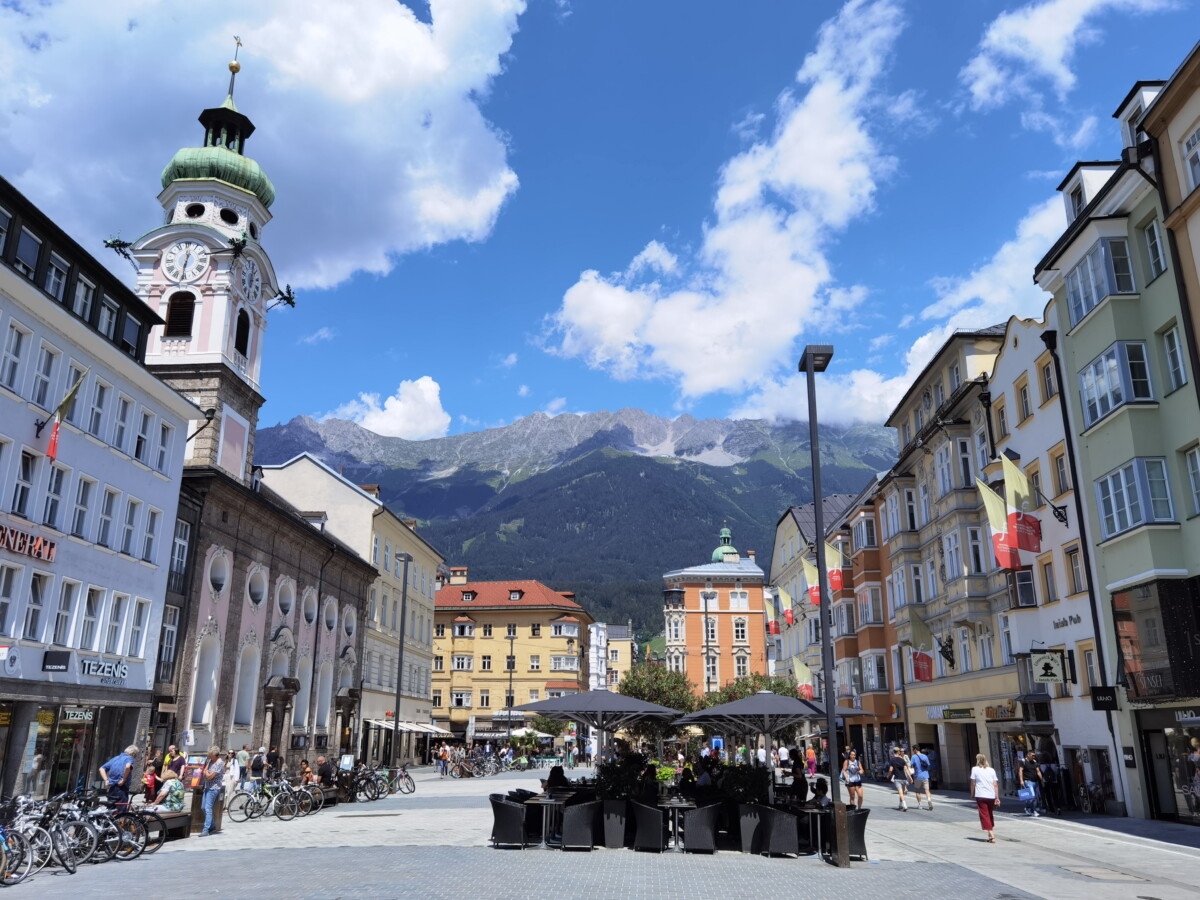
Maximilianstrasse is a major street in Innsbruck, stretching west of Maria-Theresien-Strasse. Here you’ll find magnificent Art Nouveau, Renaissance, and functional buildings from the early 20th century. Since the street was conceived at the end of the 19th century as a “homage to the Habsburgs,” it reflects the bourgeois self-confidence of that era. Today, you’ll find educational institutions, public buildings, and residential buildings along its length.
Maximilian Street in Innsbruck exemplifies how the city reinvented itself in the late 19th century. This street in Innsbruck’s city center received its name relatively late, in 1888. This was a clear homage to Tyrol’s Habsburg history . The name honors Emperor Maximilian I (1459–1519) , whose legacy – think of the Golden Roof or the Hofkirche – remains omnipresent in Innsbruck to this day.
The street was originally laid out for a practical reason : it was intended to serve as an important connecting axis linking the Triumphal Arch in the north with the municipal hospital (today’s regional hospital), which was then located in the west. Its development is therefore closely linked to the city’s expansion in the second half of the 19th century. This was a time when Innsbruck grew beyond its medieval boundaries and the southern district of Wilten became more densely populated.
In the cityscape, Maximilianstrasse, together with Maria-Theresien-Strasse and Anichstrasse, forms important thoroughfares. Maximilianstrasse begins directly south of the Triumphal Arch , where it continues southwards as a continuation of the famous Maria-Theresien-Strasse. Along its route, it intersects streets such as Anichstrasse and Leopoldstrasse before leading into the lively Wilten district. The street itself and its immediate surroundings offer numerous architectural and historical highlights that you can discover on a stroll.


Architectural highlights of Maximilianstrasse
Maximilianstrasse and its immediate surroundings offer a wealth of architectural and historical treasures. The starting point is the Triumphal Arch at its northern end. This structure, dating from 1765, is historically complex: it commemorates the wedding of Archduke Leopold, but also symbolizes mourning due to the subsequent death of Emperor Francis Stephen of Lorraine – a unique dual symbolism in European architecture.
Right at the beginning of the street stands the former main post office (Maximilianstraße 2), built between 1900 and 1905. Instead of the originally planned Baroque style, the architect Franz von Neumann opted for a more representative style, combining elements of the German Renaissance and Historicism. The facade is extremely elaborate, featuring friezes and cornices. Inside, the two-story main hall with its glass roof was a long-standing attraction. A mosaic of Emperor Franz Joseph I can still be found on the first floor . For many years, this building played a central role for all of Tyrol, serving as the post office, telegraph office, and telecommunications center. Today, it houses a branch of the savings bank and offices.
At the intersection with Leopoldstrasse, the Winklerhaus stands out. The section facing Maximilianstrasse is known for its oriel window, adorned with two mythical creatures and featuring typical Art Nouveau elements . The thought-provoking inscription on the oriel – “Let each see how he fares, Let each see where he stands, And let him who stands, lest he fall” – is a fine example of the new bourgeois self-image around the turn of the century (Source: Discover-Innsbruck).
At the southern end of the street, the Church of the Sacred Heart (Maximilianstraße 8) dominates the view . Built in 1896/97 in the Neo-Romanesque style , it commemorates the 100th anniversary of the Tyrolean vow to the Sacred Heart of Jesus. The church and the adjoining Redemptorist college are an important Catholic pilgrimage site, particularly dedicated to the veneration of Our Lady of Perpetual Help. Interestingly, part of the church also serves as a place of worship for the Serbian Orthodox community in Innsbruck (Church of the Nativity of St. John the Baptist).
Infrastructure, social affairs and culture
The central location and proximity to the university hospital have led to the establishment of important social and health-related institutions on Maximilianstrasse. Here you will find the Psychosocial Center (PSZ) Innsbruck (Maximilianstrasse 23), a central point of contact for people in psychosocial crises, and the Klinikbrücke association (Maximilianstrasse 43), which provides voluntary support to patients of the Tyrolean hospitals.
The nearby Adambräu site is of immense cultural importance. The brewhouse of the former brewery, built in 1926/27 according to plans by the renowned architect Lois Welzenbacher , is considered a significant monument of industrial architecture. Today it houses aut. architektur und tirol (Architecture Forum Tyrol) and the Archive for Architectural History of the University of Innsbruck, making it a central hub for exhibitions and discussions on architectural culture.
In everyday life, Maximilianstrasse is a vibrant microcosm: it’s an important location for local shops, service providers, and restaurants . Visitors will find branches of local bakeries/cafés like Ruetz and supermarkets like MPREIS. Smaller meeting places like the Advokat Bar Cafe or the Café-Bar Magistrat invite you to linger.
Further links
- Things to know about Innsbruck’s old town
- More tips for shopping in Innsbruck
- the best sights in Innsbruck
- The city center of Innsbruck is so beautiful