The Leopold Fountain in Innsbruck
The Leopold Fountain in Innsbruck is a unique monument and one of Innsbruck’s hidden gems. The equestrian statue depicts Leopold V in a majestic pose on his horse, which is in the levade position – meaning the horse is standing on its hind legs while its front legs are raised in the air.
Standing on Rennweg in front of the State Theatre, the rider on the fountain immediately catches your eye – that’s Archduke Leopold V. But what’s truly impressive isn’t the man himself, but his horse. For that time (we’re talking about the early 17th century), it was an absolute sensation. It was the first time in the German-speaking world that such a heavy bronze statue had been cast in such a way that the horse stood only on its two hind legs. The entire weight rests on just two points – technically, that was incredibly difficult to achieve back then without the figure toppling over or breaking.
The mastermind behind this work was Caspar Gras. He was the court sculptor here in Innsbruck and a true star when it came to bronze casting. He not only designed the Archduke and his horse, but also all the other figures seated at the bottom of the fountain. If you look closely, you can see sea gods like Neptune and various aquatic creatures. They are incredibly detailed. Caspar Gras worked on these figures for decades – so you could almost say that the fountain was his life’s work.
- Oceanus : The god of the sea, depicted in the SW corner, sits with a dolphin.
- Diana : The goddess of the hunt, in the NW corner, with a hunting spear and a stag.
- Amphitrite : The sea goddess, leaning on a vase in the northeast corner.
- Moss goddess : She embraces a crane and stands in the southeast corner.
- Neptune : On the front of the central base, he sits on a tortoise and holds a trident.
- Triton : On the east side of the central base, he sits on a dolphin and blows into a shell.

A noteworthy monument near the Hofburg Palace
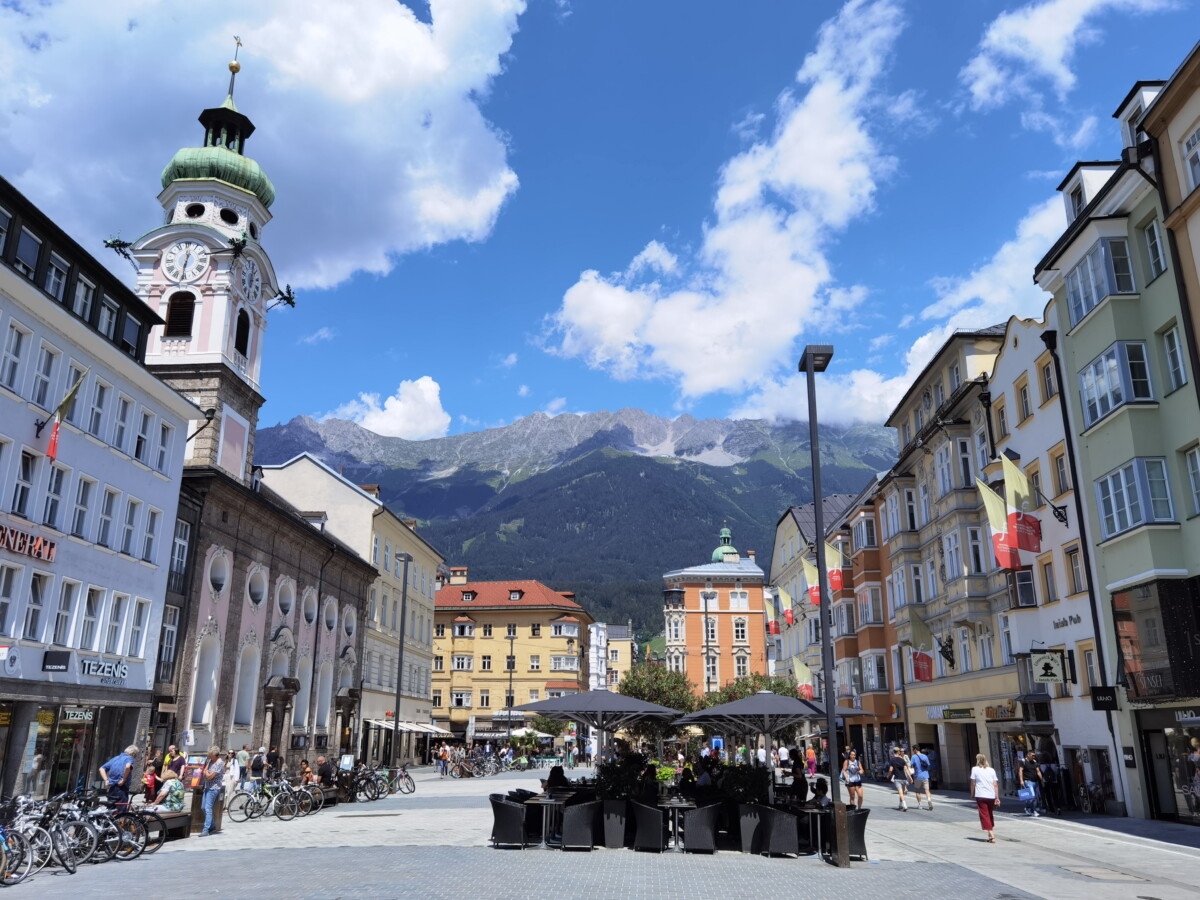
The Leopold Fountain is an outstanding example of Baroque art and architecture in Innsbruck. It is located in Innsbruck’s city center , near the historic Old Town – directly in front of the House of Music. Opposite is the Imperial Palace (Hofburg) and next to it the Court Garden (Hofgarten). The fountain is dedicated to Archduke Leopold V. The equestrian statue of Archduke Leopold V is considered one of Austria’s most important early Baroque monuments. It is not only a work of art, but also an expression of Leopold’s absolutist claim to power.
What many don’t know: The fountain wasn’t always located where it stands today. The equestrian statue was actually completed around 1622, but then the Thirty Years’ War and the death of the Archduke intervened. The project languished for ages. The statue was repeatedly moved around and even ended up in different storage locations at one point. It wasn’t until much later, at the end of the 19th century, that the old designs were remembered and the monument was finally erected as we see it today. It’s considered one of Innsbruck’s hidden gems .
MONUMENT AT THE HOFBURG INNSBRUCK
The Leopold Fountain is an impressive monument located directly in front of the Hofburg Palace in Innsbruck. This artistic fountain ensemble is a symbol of Baroque art and the history of Tyrol. The Hofburg Palace in Innsbruck and the adjacent Court Garden together form an impressive historical and cultural landmark in the Tyrolean capital. The Hofburg is one of the most important Baroque buildings in Innsbruck and once served as the residence of the Habsburgs. Originally built in the 15th century as a Gothic structure, it was remodeled and expanded several times over the centuries, particularly in the 18th century, when it acquired its current Baroque form. –> Hofburg Innsbruck
MONUMENT AT THE COURT GARDEN INNSBRUCK
Directly adjacent to the Imperial Palace lies the Court Garden, one of Innsbruck’s oldest gardens. Laid out in the 17th century in the Italian style, it offers a tranquil retreat in the heart of the city. With its manicured lawns, magnificent flowerbeds, and shady trees, the Court Garden invites visitors to linger and relax. A highlight of the Court Garden is the impressive view of the Nordkette mountain range, which rises majestically in the background. The garden is not only a place for recreation but also a popular venue for cultural events and concerts. –> Court Garden Innsbruck
FROM LEOPOLD’S FOUNTAIN TO THE TOP OF INNSBRUCK
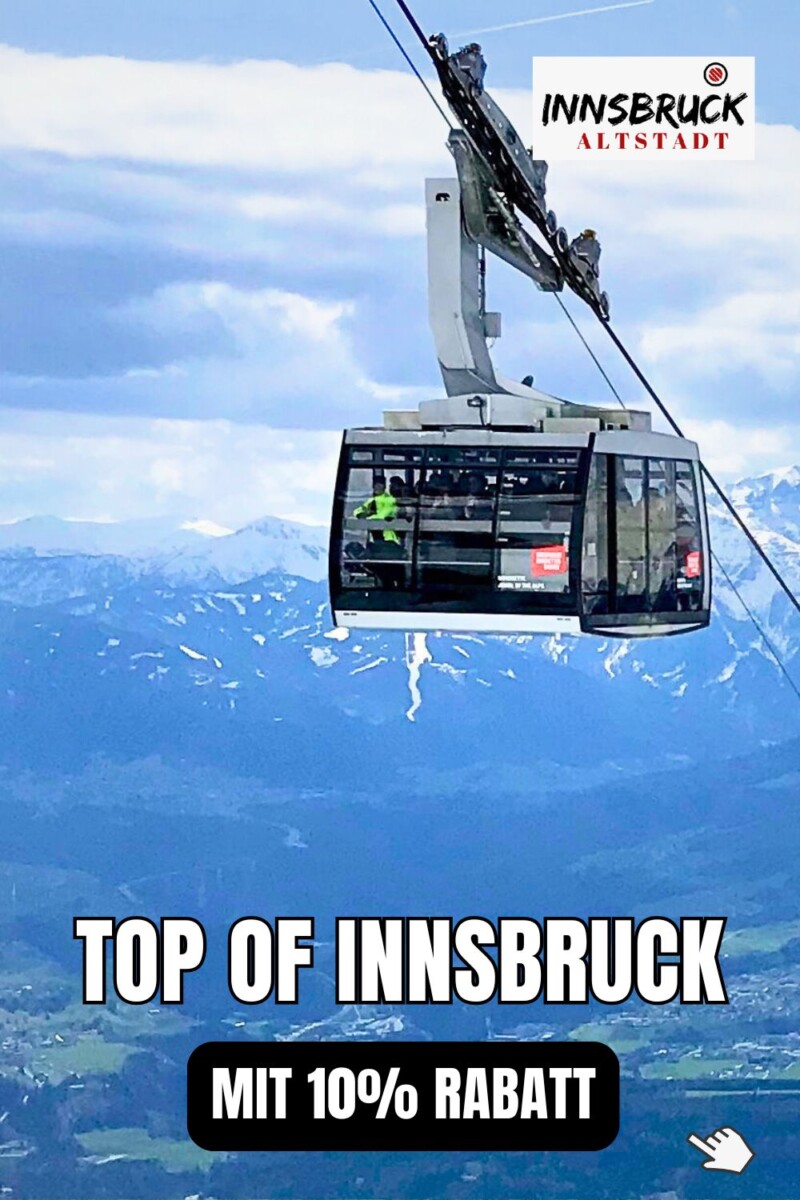
Near the Leopold’s Fountain, the Hungerburgbahn funicular railway departs from the Congress Innsbruck and takes you to the Top of Innsbruck. The Hungerburgbahn is an impressive cable car that effortlessly transports visitors to Hungerburg and further up to the “Top of Innsbruck.” This destination offers not only breathtaking views of the city of Innsbruck and the surrounding mountains, but also numerous leisure activities, including hiking trails, ski resorts, and outdoor recreational opportunities. –> Take the Hungerburgbahn to the Top of Innsbruck
FROM LEOPOLD’S FOUNTAIN TO INNSBRUCK’S OLD TOWN
From the Leopold Fountain, you can reach Innsbruck’s Old Town directly via Hofgasse. Hofgasse is a charming, narrow lane that begins right behind the fountain. Surrounded by historic buildings, cobblestone streets, and small shops, the lane immediately conveys a sense of history and tradition. After just a few minutes’ walk, you’ll reach the famous Golden Roof, Innsbruck’s most recognizable landmark. The roof is covered with 2,657 fire-gilded copper shingles and gleams in the sunlight. It was built in the 15th century for Emperor Maximilian I and served as a balcony for the imperial family to observe the events in the square. –> Golden Roof
Further links
- everything about Innsbruck’s old town
- Extensive list of Innsbruck sights
- That’s worthwhile in Innsbruck when it’s raining