

Landhausplatz Innsbruck
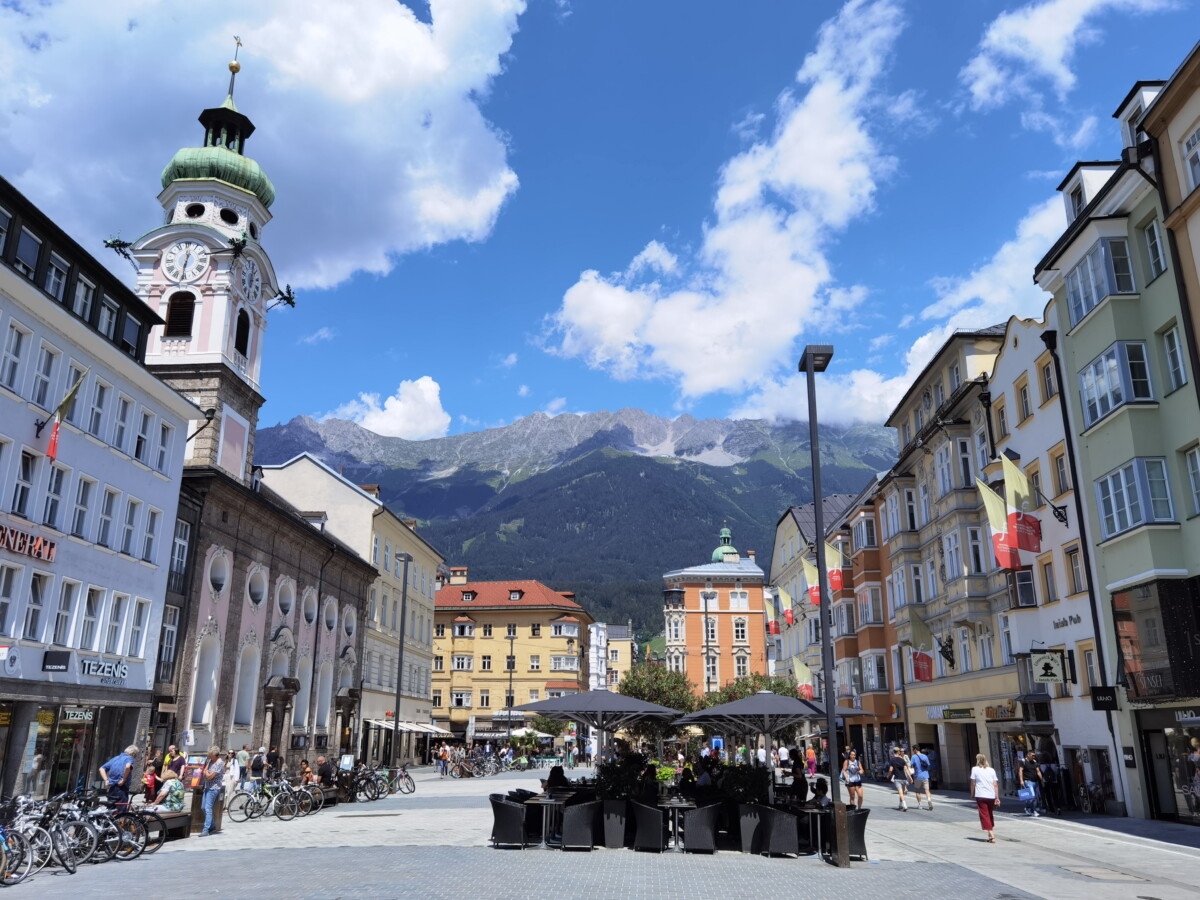
The square is located in Innsbruck’s city center, directly at the southern end of the famous Maria-Theresien-Straße. It forms the link between the historic old town and the main train station. Its history is intertwined with the political events of Tyrol in the 20th century.
Many people only know the square as “Landhausplatz.” It was officially named after Eduard Wallnöfer , a former governor of Tyrol, in 1994. The New Landhaus (state government building) stands directly on the square. It is the seat of the Tyrolean state government and parliament (Landtag). You are therefore standing right in the political center of Tyrol. The large, dominant building (the Landhaus) was originally built as a Gauhaus ( regional headquarters) during the Nazi era (1938–1939). It was intended to be a monumental center of power. The square itself was completely redesigned starting in 2007. The undulating, smooth concrete and stone surfaces form a modern sculpture, creating a clear, deliberate contrast to the monumental Nazi architecture of the Landhaus.
Landhausplatz in Innsbruck is a trapezoidal square in the southern part of Innsbruck ‘s city center . It is bordered to the north by the New Landhaus (state government building) and to the east by Wilhelm-Greil-Straße, while Salurner Straße marks its southern edge. A row of buildings with several passageways, including Fuggergasse and Welsergasse , separates it from Maria-Theresien-Straße to the west. Originally, the area was developed with a manor house, villas, and gardens, bisected by Fuggergasse and Welsergasse.
Today, the Liberation Monument and the Pogrom Memorial stand in the square . Due to its smooth, wide surfaces, the square is very popular with skaters and BMX riders . It is often very busy, especially in the evenings. In summer , concerts, markets, and political rallies are frequently held here . It is the largest open event space in Innsbruck’s city center .
What is there to see at Landhausplatz?
Eduard Wallnöfer Square in Innsbruck is an important public square in the city center. The square is named after Eduard Wallnöfer, an Austrian politician who served as Governor of Tyrol from 1963 to 1983. Eduard Wallnöfer Square contains several monuments commemorating important events and figures. One of the most famous monuments is the Liberation Monument , erected in 1948 by the French military administration under Emile Béthouart, based on plans by Jean Pascau. The monument consists of a white marble-clad gateway with five openings, each containing wrought-iron grilles displaying the coats of arms of the Austrian federal states arranged in a cross. The monument is crowned by a sculpture of the Tyrolean eagle designed by Emmerich Kerle.
Another important monument on Eduard-Wallnöfer-Platz is the monument commemorating 600 years of Tyrol’s incorporation into Austria . Erected in 1963 to mark the 600th anniversary of Tyrol’s incorporation into Austria, it was commissioned by the province and designed by architect Franz Kotek. The monument consists of an 8-meter-long and 1.15-meter-high pedestal made of greenish Sarner porphyry. A bronze relief, created by Josef Bachlechner the Younger, stands atop the pedestal. On the left is the seal of Margaret Maultasch, and next to it, in smaller reliefs, are the seals and names of the other princes who had confirmed the charter transferring Tyrol to the Habsburg Rudolf IV.
A significant monument in the square is the Pogrom Memorial , erected in 1997 to commemorate the Innsbruck victims of the November pogroms of 1938. It consists of a copper base with shards of glass and the names of the victims, as well as a seven-meter-high menorah.
Another monument in the square is the Unification Fountain . This was erected in 1906 at the train station square (today’s Südtiroler Platz) to commemorate the unification of Wilten and Pradl with Innsbruck in 1904. The fountain was dismantled in 1940 for traffic reasons. A committee for the construction of a new Unification Fountain was founded in 1992, and the fountain was finally erected in 1999 at the southern end of Landhausplatz.
Dispute over Landhausplatz in Innsbruck
Since the redesign of Landhausplatz in the 2000s, there have been recurring and controversial discussions among locals. Construction defects repeatedly cause public outcry. Hundreds of thousands of euros in renovation work are needed. Many Innsbruck residents are demanding the removal of the stark, concrete plaza. They advocate for a park in the heart of the city instead of a barren, concrete expanse. Especially in summer, the concrete surface heats up, making the plaza an unappealing place to linger.
Related Links:
- from Eduard-Wallnöfer-Platz you can go directly in the Maria-Theresien-Straße
- Overview Of Park Houses Innsbruck
- discover these Innsbruck attractions
- so beautiful is the old town of Innsbruck